

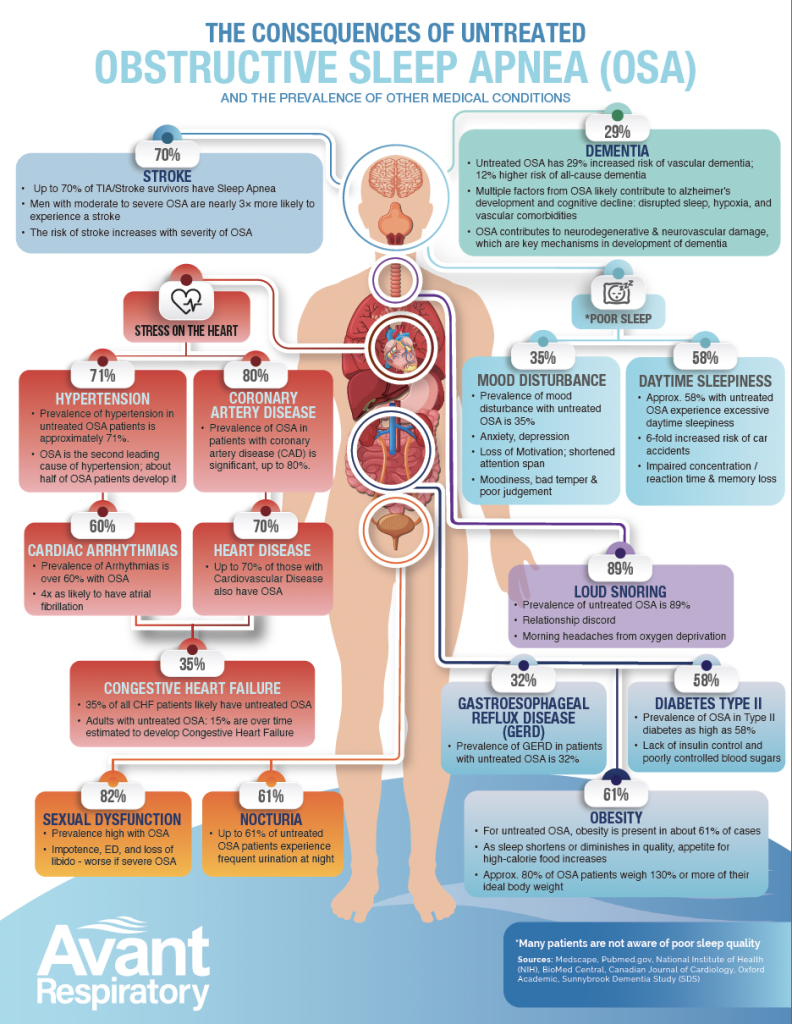
STROKE
- Up to 70% of TIA/stroke survivors have Sleep Apnea.
(Study Details | NCT04322162 | Addressing Sleep Apnea Post-Stroke/TIA | ClinicalTrials.gov)
- Men with moderate to severe OSA are nearly 3x more likely to experience a stroke compared to those without OSA. (PubMed, Sleep apnea as a risk factor for stroke)
- The risk of stroke increases directly with the severity of OSA, with more severe cases posing a higher risk. (PubMed, Obstructive sleep apnea and risk of stroke: a meta-analysis)
DEMENTIA
- Untreated OSA has been linked to a 29% increased risk of vascular dementia and a 12% higher risk of all-cause dementia.
(Study Details | NCT01800214 | The Sunnybrook Dementia Study | ClinicalTrials.gov)
- Multiple factors stemming from OSA, including disrupted sleep architecture, recurrent hypoxia, and associated vascular comorbidities, are believed to contribute to the development of Alzheimer's disease and broader cognitive decline.
(PubMed, Obstructive sleep apnea and Alzheimer's disease: a systematic review)
- OSA contributes to neurodegenerative and neurovascular damage, which are identified as key mechanisms in the progression of dementia.
(Oxford Academic, Sleep Medicine, Obstructive Sleep Apnea &Dementia: A Systematic Review)
STRESS ON THE HEART
HYPERTENSION
- The prevalence of hypertension in patients with untreated OSA is approximately 71%.
(Medscape, Obstructive Sleep Apnea and Hypertension)
- OSA is recognized as the second leading cause of hypertension, affecting approximately half of all OSA patients who develop the condition.
(National Institutes of Health (NIH), Sleep Apnea and High Blood Pressure)
CORONARY ARTERY DISEASE
- The prevalence of OSA in patients diagnosed with coronary artery disease (CAD) is notably high, impacting up to 80% of individuals. (Canadian Journal of Cardiology, Sleep apnea and coronary artery disease: a state of the art review)
CARDIAC ARRHYTHMIAS
- The prevalence of cardiac arrhythmias in individuals with OSA exceeds 60%, with OSA patients being approximately 4 times as likely to experience atrial fibrillation.
(PubMed, Sleep apnea and cardiac arrhythmias)
HEART DISEASE
- Up to 70% of individuals with cardiovascular disease are also found to have OSA.
(Medscape, Obstructive Sleep Apnea and Heart Disease)
CONGESTIVE HEART FAILURE
- Approximately 35% of all patients diagnosed with Congestive Heart Failure (CHF) are likely to have untreated OSA. (PubMed, Sleep apnea in congestive heart failure)
- Adults with untreated OSA are estimated to develop Congestive Heart Failure over time, with a 15% increased risk.
(PubMed, Obstructive sleep apnea and risk of incident heart failure: a meta-analysis)
POOR SLEEP
MOOD DISTURBANCE
- The prevalence of mood disturbances, including anxiety and depression, in individuals with untreated OSA is reported at 35%.
(PubMed, The relationship between obstructive sleep apnea and mood disorders)
- These disturbances can manifest as symptoms such as anxiety, depression, loss of motivation, shortened attention span, moodiness, bad temper, and poor judgment.
(NIH, Sleep Deprivation and Deficiency)
DAYTIME SLEEPINESS
- Approximately 58% of individuals with untreated OSA experience excessive daytime sleepiness. (BioMed Central, Excessive daytime sleepiness and incident stroke risk in individuals with obstructive sleep apnea)
- Untreated OSA leads to a 6-fold increased risk of car accidents due to impaired alertness. (PubMed, Sleep apnea and motor vehicle accidents: a meta-analysis)
- Cognitive impairments such as impaired concentration, slowed reaction time, and memory loss are common consequences. (NIH, What Are the Signs and Symptoms of Sleep Apnea?)
SEXUAL DYSFUNCTION
- A high prevalence of sexual dysfunction is observed in patients with OSA.
(Medscape, Obstructive Sleep Apnea and Sexual Dysfunction)
- This can include impotence, erectile dysfunction (ED), and loss of libido, with these issues often worsening with the severity of OSA. (PubMed, Obstructive sleep apnea and sexual dysfunction in men: a systematic review and meta-analysis)
NOCTURIA
- Up to 61% of individuals with untreated OSA experience frequent urination during the night (nocturia). (PubMed, The association between obstructive sleep apnea and nocturia: a systematic review and meta-analysis)
GASTROESOPHAGEAL REFLUX DISEASE (GERD)
- The prevalence of GERD in patients with untreated OSA is estimated to be 32%.
(Medscape, Obstructive Sleep Apnea and GERD)
DIABETES TYPE II
- The prevalence of OSA in Type II diabetes patients can be as high as 58%.
- OSA is associated with poor insulin control and poorly regulated blood sugar levels.
(NIH, Sleep Apnea and Type 2 Diabetes)
OBESITY
- Obesity is present in approximately 61% of untreated OSA cases.
(PubMed, Prevalence of obesity in obstructive sleep apnea)
- Diminished sleep quality and duration due to OSA can increase appetite for high-calorie foods, contributing to weight gain. (NIH, How Does Sleep Affect Weight?)
- Approximately 80% of OSA patients weigh 130% or more of their ideal body weight.